IEAM · MIGRATION ANALYSIS · 5 NOV 2026
Nationality, the electoral register and participation ahead of the general election
How much weight does the so-called “binational vote” carry in an election? Before answering, we need to know what we are counting. Nationality, place of birth, residence and electoral registration describe different realities. Distinguishing between them helps us interpret the figures more accurately and examine the conditions that make participation possible.
A general election has been called for 29 November 2026 under Royal Decree 806/2026 of 5 October, published on 6 October in the Official State Gazette (BOE).[1] One question arises: what role will the binational vote play? Answering it requires distinguishing between four related but different situations that are often confused. Holding two nationalities, having been born in another country, having acquired Spanish nationality and being entitled to vote are circumstances that do not necessarily coincide.
One label for different realities
The expression “binational vote” can refer to different populations: people with dual nationality, such as Spanish and Cuban, Spanish and Argentinian, or Spanish and Colombian; naturalised Spanish citizens born in another country, some of whom retain their previous nationality while others do not; and Spanish citizens living abroad who are registered in CERA, whether or not they hold another nationality. They should be distinguished from foreign nationals residing in Spain without Spanish nationality, who, as a general rule, cannot vote in elections to the Congress of Deputies and the Senate. Reciprocity agreements for voting in municipal elections do not extend to general elections.[4]
The growth of the Spanish electorate of migrant origin does not automatically mean growth in the population that formally holds two nationalities. The electoral register tables cited do not identify binational people, their migrant background or the other factors that might influence their participation.
An intersectional perspective allows us to analyse how gender, age, national origin, migration history, working conditions, care responsibilities and place of residence may combine to facilitate or hinder political participation in this election. Descriptive data alone cannot tell us how a group will vote; they can, however, provide useful indications to consider.
The figures and their limits
According to the Electoral Census Office of Spain’s National Statistics Institute (INE), the figures published on 9 October 2026 put the electoral register available for public consultation ahead of the general election at 38,728,356 people, of whom 2,769,645 are registered as residents abroad.[2]
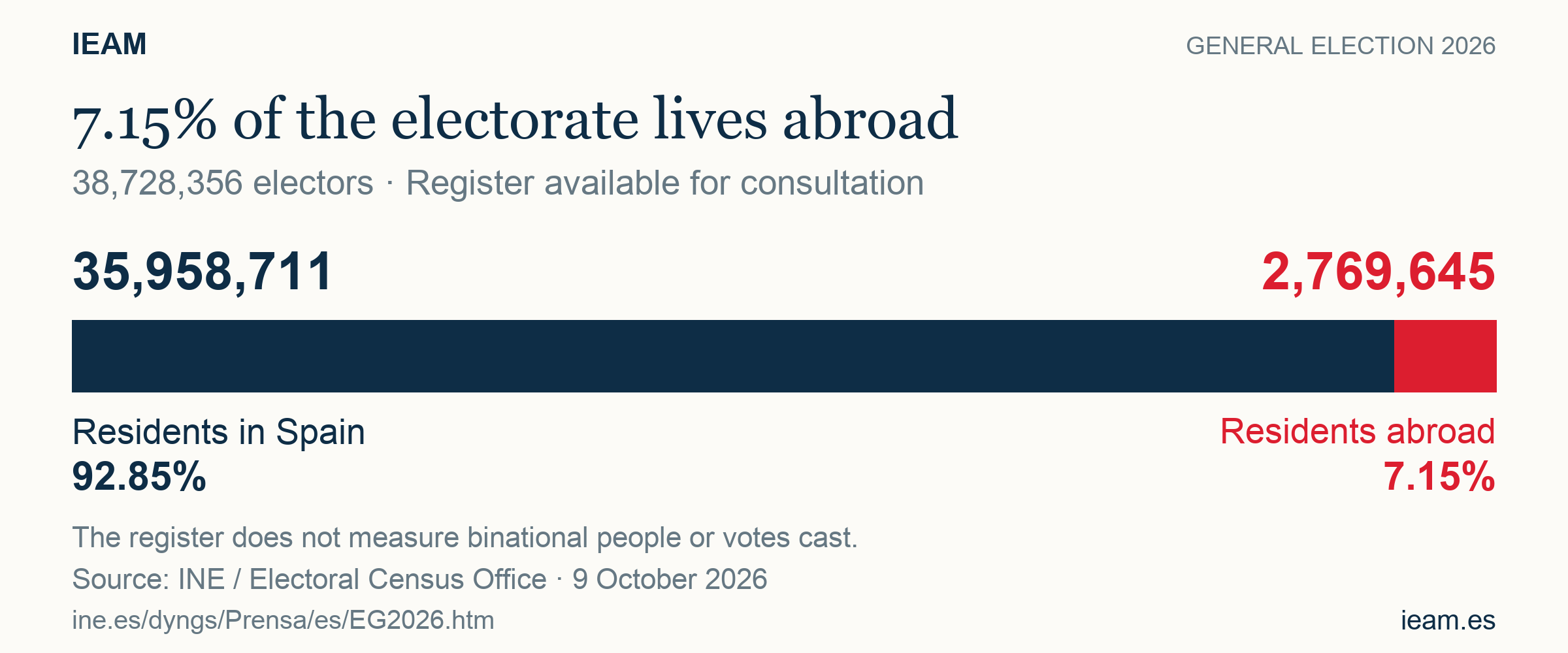
The same release identifies 1,615,127 residents in Spain who will be able to vote in a general election for the first time, having turned 18 since the election of 23 July 2023.[2] They are new electors by age, not necessarily migrants or binational people. These figures refer to the register available for consultation, not to votes cast or to a definitive assessment of subsequent judicial decisions.
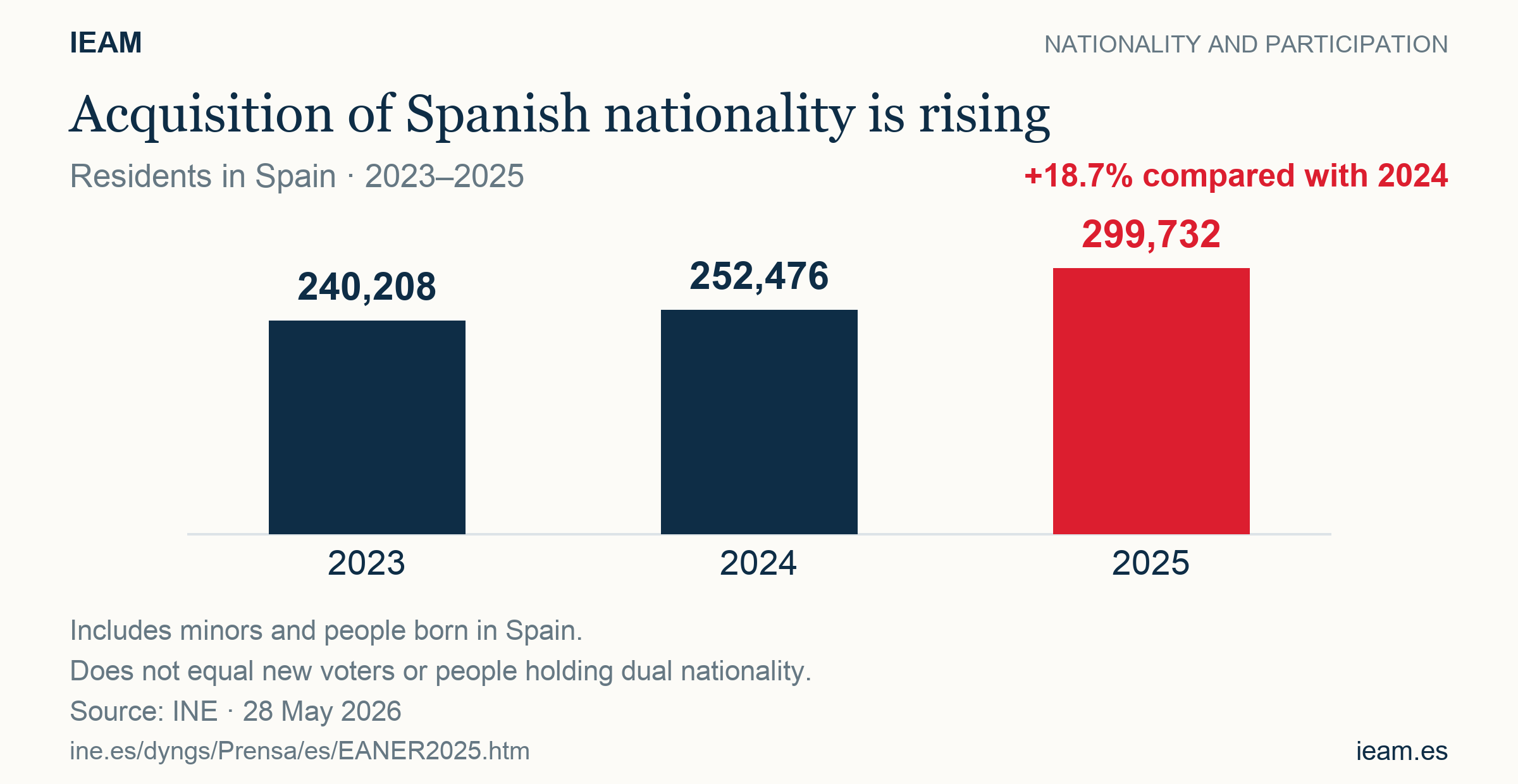
In 2025, 299,732 acquisitions of Spanish nationality by residents in Spain were recorded (INE, 2026).[3] The statistics include minors and people born in Spain, and exclude acquisitions by people residing in other countries. Acquiring nationality therefore does not automatically mean becoming a new voter or holding dual nationality.
The geography of voting from abroad
What the INE does allow us to identify is the electorate residing abroad and registered in CERA. Fourteen countries have more than 50,000 Spanish electors; eight of them are in Latin America or the Caribbean: Argentina, Mexico, Cuba, Brazil, Venezuela, Uruguay, Chile and Colombia. This distribution shows the importance of Latin America and the Caribbean within the electorate abroad.[2]
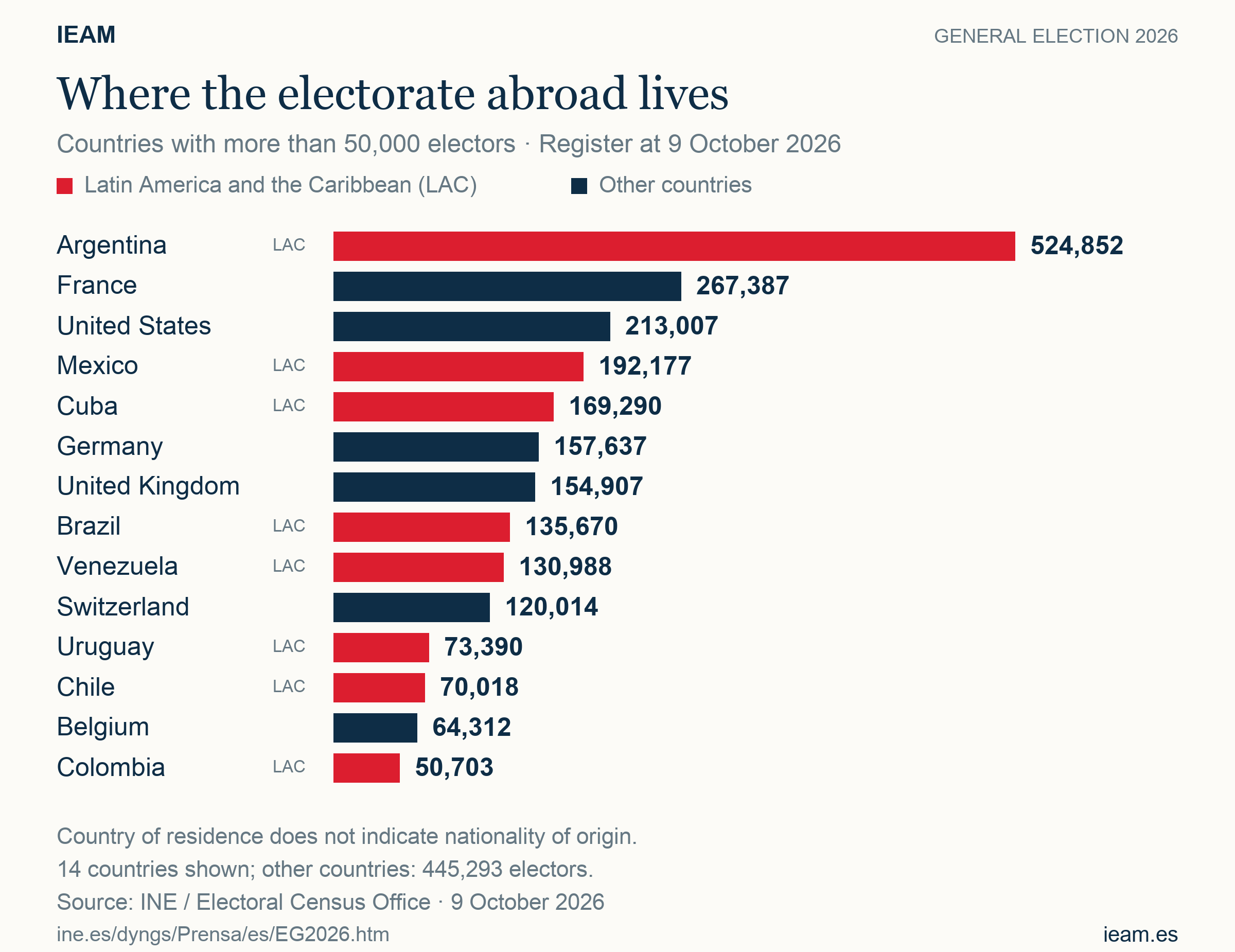
Two points should be considered. Residence does not determine national origin: these may be Spanish citizens born in those countries or citizens of different origins living there. The historical dimension of the growth of voting from abroad also matters. It should be analysed in relation to the acquisition of nationality by descendants of Spanish citizens, return migration and movements between Spain and Latin America.
This distribution raises a question: how does registration translate into participation? Distance, working hours, care responsibilities and access to understandable information are dimensions worth investigating, without treating their effects as established by electoral register data alone.
The Democratic Memory Law and safeguards for voting
Part of the debate concerns those who acquired nationality through the first clause of paragraph 1 of the eighth additional provision of the Democratic Memory Law, known as the “grandchildren’s law”, and whose registration in CERA has had its electoral effects provisionally suspended by a Supreme Court decision. The order of 12 October 2026 establishes that the suspension will not apply where officials responsible for consular civil registries certify that, as of 1 August 2026, the beneficiaries met the requirements: having been born outside Spain and being the children or grandchildren of people who were originally Spanish and had lost or renounced their nationality as a consequence of exile for political or ideological reasons, reasons of belief, or reasons of sexual orientation or gender identity. The presumption of exile provided for in the 2022 instruction cannot be applied for this certification.[5]
This measure also raises another issue: it cannot be assumed that everyone naturalised under the Democratic Memory Law effectively holds dual nationality. The list submitted by the Government to the Supreme Court on 28 October 2026 contains 163,355 people, compared with the 163,020 initially reported, according to EFE; this figure is not equivalent to the definitive number of people who will be unable to vote.[6] A rights-based assessment should consider the clarity of procedures for verifying nationality and registration requirements; the proportionality of the measures and their consequences for suffrage; individual notification, the opportunity to make representations and effective judicial protection; unequal effects on communities concentrated in particular countries; and the transparency and quality of the data used to make decisions affecting political rights.
From figures to the conditions for participation
An intersectional perspective invites us to look at differences within each group. Sharing a nationality or country of residence does not mean sharing an age, employment situation, family responsibilities or migration history. Research should therefore compare general data with individual experiences.
A methodological proposal for a subsequent study of the binational vote from an intersectional perspective could be organised as follows:
| Dimension | Source or method | Indicators |
|---|---|---|
| Electoral register | INE and Electoral Census Office | Electors by constituency and residence in Spain or abroad. |
| Naturalisation | INE | Sex, age, previous nationality and route of acquisition. |
| Dual nationality | Population census and demographic tables | Country of the other nationality, sex and age, subject to availability. |
| Participation | Election results and surveys | Turnout, abstention and voting intention. |
| Gender and care | Surveys and interviews | Time available, care responsibilities, employment and access to information. |
| Origin and belonging | Surveys and interviews | Self-identification, discrimination, transnational networks and belonging. |
| Democratic Memory Law | BOE, judicial decisions and consular data | Route of acquisition, electoral registration and legal status. |
Beyond the count
The binational vote cannot be measured with a single figure. The electoral register, dual nationality, acquisition of citizenship and voting behaviour are related but distinct phenomena. The data cited show an electorate abroad of almost 2.77 million people and a significant number of acquisitions of Spanish nationality, with variation by sex, age and origin.[2][3]
Rigorous intersectional research should connect these figures with the material conditions for participation, without attributing political preferences to a nationality or gender on the basis of stereotypes. The central question is not only how many binational people can vote, but which conditions facilitate or limit their participation and how these vary by gender, age, origin and migration history.
Sources
[1] BOE. Royal Decree 806/2026 of 5 October. Published on 6 October 2026, article 2. View source
[2] INE. Elections to the Spanish Parliament on 29 November 2026. Electoral register available for consultation and electors by country of residence. Release of 9 October 2026. View source
[3] INE. Statistics on Acquisition of Spanish Citizenship by Residents. Year 2025. Results and methodological note published on 28 May 2026. View source
[4] BOE. Spanish Constitution, article 13.2. View source
[5] BOE. Operative part of the Supreme Court order of 12 October 2026. Published on 15 October 2026. BOE-A-2026-21447. View source
[6] EFE. The Government identifies before the Supreme Court the 163,355 people affected by the grandchildren’s law. 28 October 2026. View source