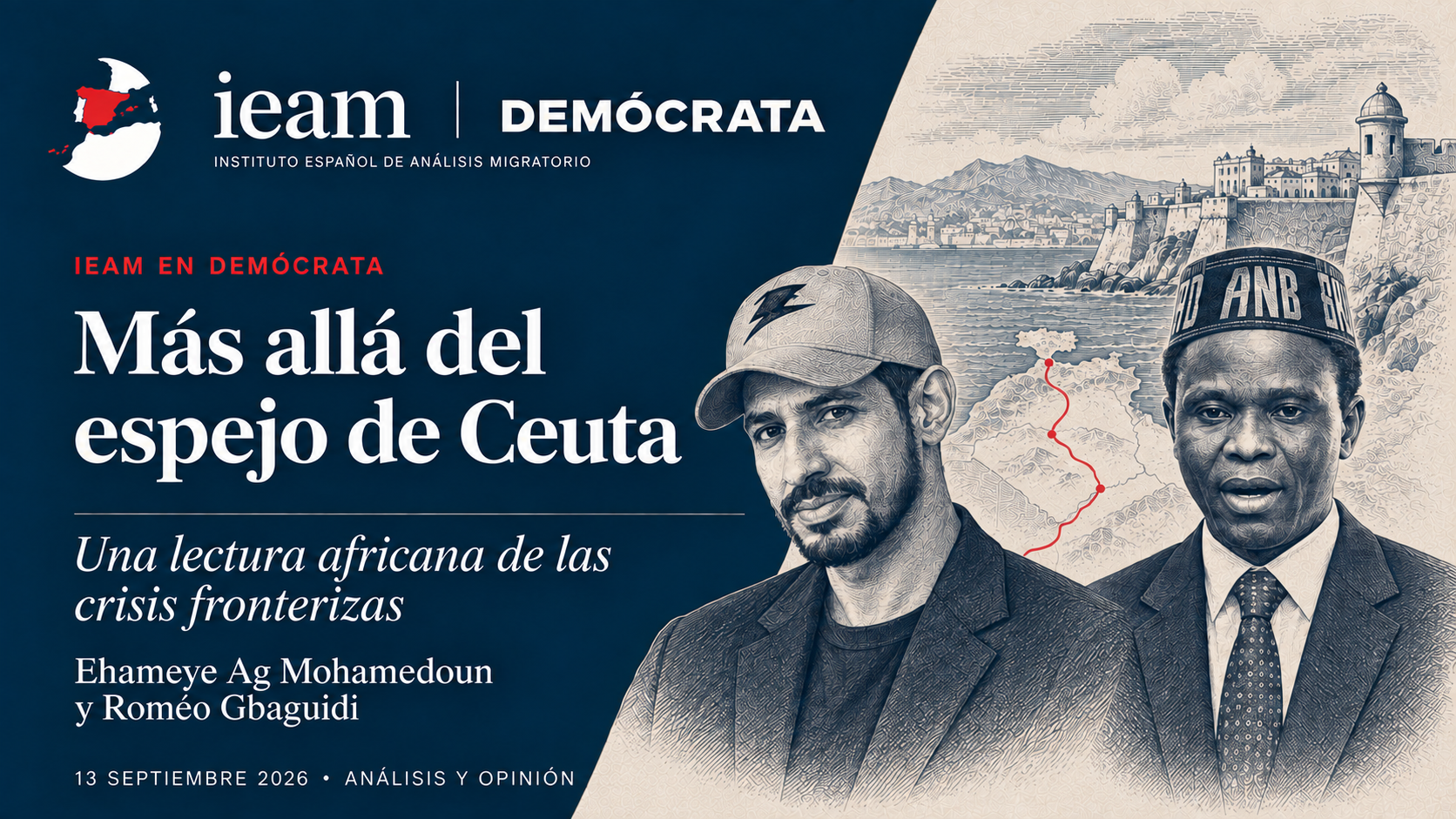
The IEAM associate researchers analyze in DEMÓCRATA the recent Ceuta crisis through the lens of Sahelian migration dynamics, and call on Europe to move from border control to a strategy built on anticipation.
Ehameye Ag Mohamedoun and Roméo Gbaguidi, associate researchers at the Spanish Institute for Migration Analysis (IEAM).
DEMÓCRATA has published an opinion article by Ehameye Ag Mohamedoun and Roméo Gbaguidi, associate researchers at the Spanish Institute for Migration Analysis (IEAM), titled "Beyond the Mirror of Ceuta: An African and Structural Reading of Border Crises." The piece argues that what happened in Ceuta should not be read as a temporary border management failure or a security emergency, but as the visible symptom of deeper structural shifts in sub Saharan mobility.
A shock wave from further south
The authors argue that while European public opinion tends to see events like Ceuta through the metaphor of a "wave" crashing at Europe's gates, the view from West Africa and the Sahel is different. Ceuta, they write, is not the start of a crisis but the inevitable symptom of structural changes in sub Saharan mobility that Europe insists on addressing only through the logic of closing borders.
The illusion of closure
The article examines the effects of Europe's long standing strategy of externalizing border control, pushing the line of defense deep into the Sahel. According to the authors, tighter controls and the criminalization of traditional routes have not reduced migrants' desire to move; instead they have transformed and professionalized the trafficking networks that move them. They describe an "industrialization" of migratory flows in the Sahel, with traffickers increasingly relying on GPS guided night convoys, Starlink terminals and satellite phones to cross the border zones of Mauritania, Algeria and Mali.
Rising costs, rising risk
The authors point to a clear economic and human cost to this hardening of controls. As traditional routes close, migrants are pushed onto unmarked and extremely dangerous desert paths. This shift allows criminal groups to impose what the authors call "revolutionary taxes," raising fees by at least 40% on some key stretches, and in some cases trapping migrants in forced labor or debt bondage to pay off transport costs.
Different profiles, different scale
The article notes that those who crossed during the recent events in Ceuta were mostly adolescents and young people from urban and peri urban areas of Morocco, driven by precarity, unemployment and a lack of prospects. The authors warn that a scenario dominated instead by sub Saharan migrants stuck for months or years in transit countries, and dependent on trafficking networks, would pose a challenge of an entirely different scale for reception systems and European diplomacy.
The fragility of externalization
The piece highlights the structural fragility of a model based on outsourcing border control to third countries. When a partner state ties border management to its own bilateral or geopolitical interests, the authors argue, the border stops being a space of legal regulation and becomes a tool of strategic pressure. Europe's heavy reliance on the policing cooperation of third countries, they write, weakens its own migration governance and leaves it exposed whenever diplomatic relations deteriorate. The new Pact on Migration and Asylum, in force since June 2026, still focuses on managing crises once they reach European soil, without addressing the socioeconomic and security conditions in countries of origin and transit.
A call for a paradigm shift
The authors call for border security and respect for human rights to be treated as two inseparable pillars of a sustainable policy, rather than as competing goals. They set out four priorities for Europe and its African partners:
Replacing reaction with anticipation grounded in on the ground knowledge of settlement, recruitment and blockage dynamics along Sahel and Maghreb routes.
Treating community organizations and local civil society actors as key sources of information, since they document realities such as forced debt and route restructuring that statistics alone miss.
Investing in territorial development and legal mobility, addressing the social exclusion and lack of prospects affecting young people in both the Maghreb and the Sahel.
Developing humanitarian protection corridors and regulated mobility channels to replace clandestine routes, undercutting the economic model that sustains trafficking networks.
A shared responsibility
The article closes by describing borders as points of convergence for development inequalities and failures of global governance, not simply lines that can be sealed by force or outsourced to third countries. The authors argue that reinforcing policing alone is a dangerous illusion against movements driven by economic precarity and lack of opportunity, and call for a more balanced bilateral and multilateral cooperation, grounded in transparency, investment in youth and genuine respect for fundamental rights.