20minutos
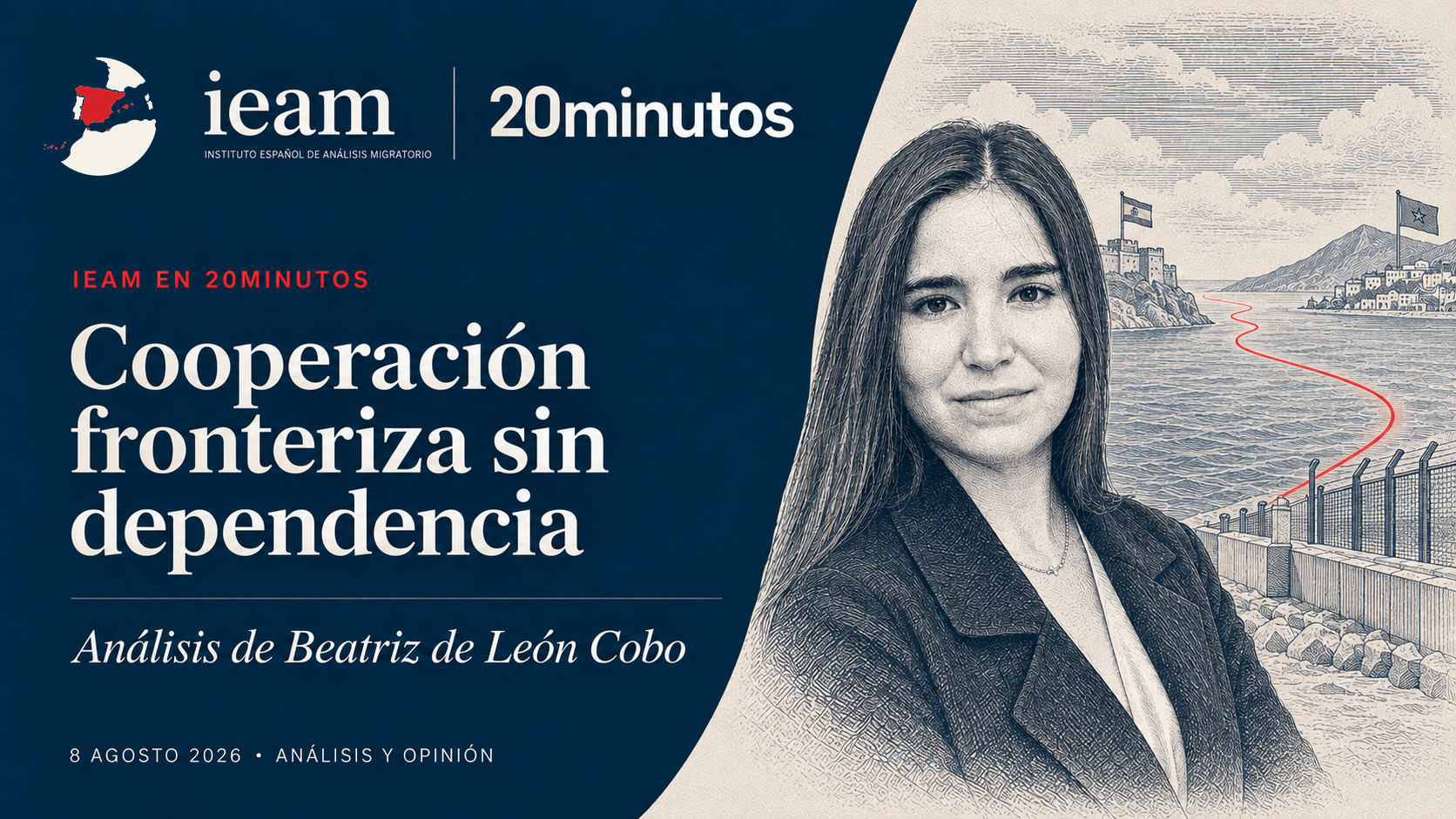
IEAM’s Executive Director examines the limits of border externalisation and argues that cooperation with Morocco must be complemented by stronger independent operational capacity, anticipation and European coordination.
08 AUG 2026 · IEAM Team · 6 min read
IEAM contributed to a 20minutos report on the recent Ceuta border crisis and the challenges it poses for Spanish and EU migration and security policies.
Beatriz de León Cobo analyses Morocco’s essential role in managing Spain’s southern border, while highlighting a key lesson from recent events: Spain needs its own operational capacity.
The limits of externalisation
Cooperation with third countries has become a major instrument of European migration policy. Spain’s collaboration with Morocco, Mauritania, Senegal, Gambia and other countries has helped reduce pressure along several routes. The report points to the sharp fall in irregular arrivals in the Canary Islands compared with the same period of the previous year.
For IEAM, however, successful cooperation does not remove the need to examine its limitations. Spain and the European Union need to work with neighbouring states, but this cooperation should not become the sole protection for an EU external border.
Cooperation backed by independent capacity
When movements along a route depend heavily on a third country’s ability or willingness to control departures, that country gains a particularly significant position in the bilateral relationship.
Cooperation should therefore be stable, transparent, predictable and verifiable, and supported by independent instruments that allow a response when circumstances change.
Turning early warning into action
One proposal highlighted in the report is to strengthen permanent early-warning mechanisms: monitoring networks and migration movements, improving real-time information sharing and establishing protocols to activate reinforcements before thousands of people gather near a border.
Once a situation reaches that scale, responding becomes more difficult both operationally and in terms of protecting migrants themselves.
A European strategy for Ceuta and Melilla
IEAM argues that protecting Ceuta and Melilla must form part of a European strategy. Bilateral cooperation between Spain and Morocco will remain essential, but greater EU coordination reduces vulnerabilities arising from an exclusively bilateral relationship and helps share responsibility for a common border.
European border policy needs to combine external cooperation, independent capacity, anticipation and solidarity among member states.
The report by Nacho Muñoz Jiménez was published by 20minutos on 8 August 2026 under the title La crisis de Ceuta pone a prueba la política fronteriza de la UE: «La cooperación no puede convertirse en dependencia».