CGTN Europe
IEAM’s Executive Director joins The Agenda to discuss the lessons of the Ceuta crisis and why migration management requires border controls, protection, external cooperation and anticipation.
15 AUG 2026 · IEAM Team · 5 min read
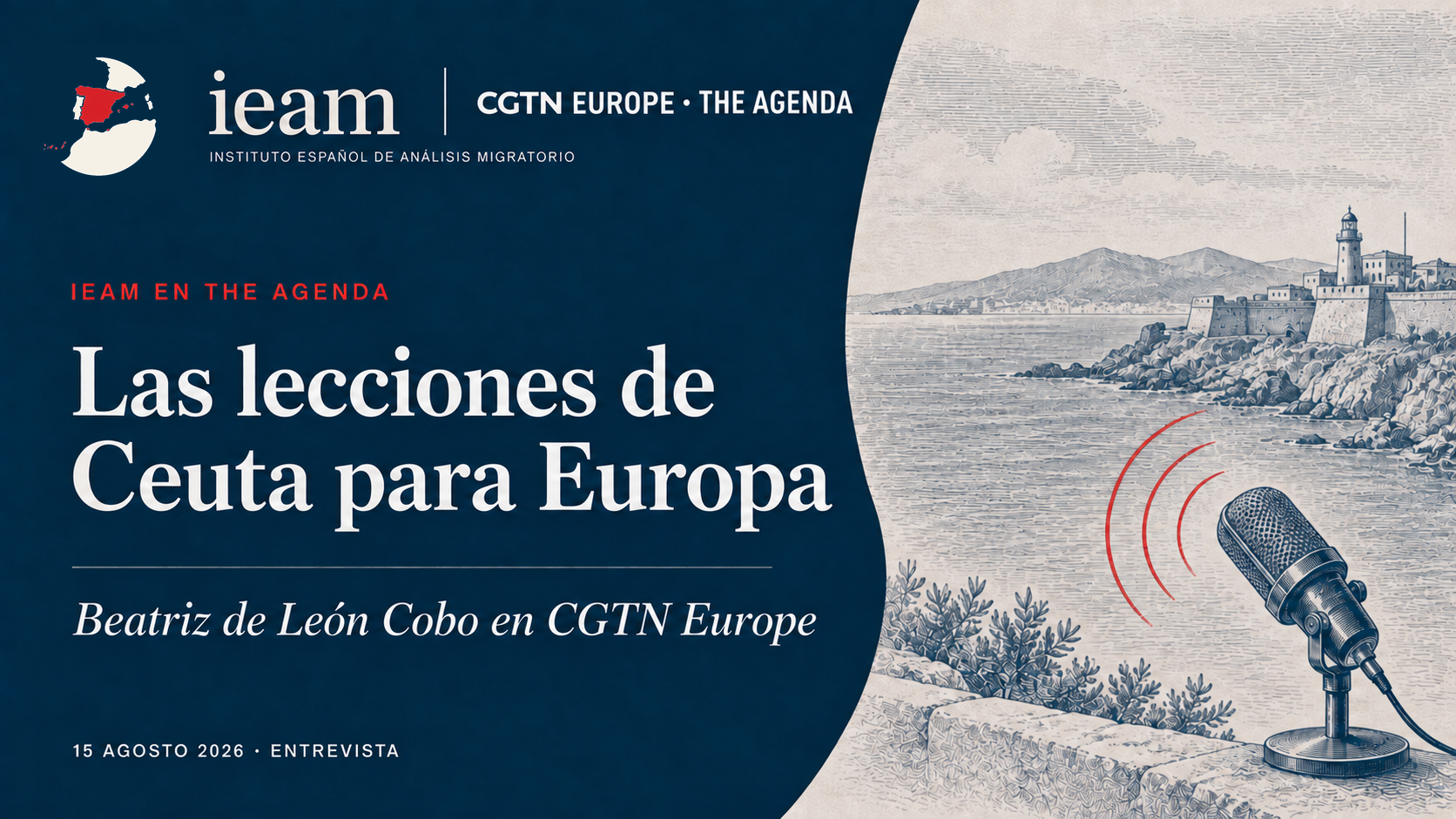
Beatriz de León Cobo, Executive Director of the Instituto Español de Análisis Migratorio —IEAM—, took part in CGTN Europe’s The Agenda to analyse the consequences of the recent Ceuta crisis and Europe’s challenges in managing its external borders.
Other participants included Anna Terrón Cusí, Senior Fellow at the Migration Policy Institute and former Spanish Secretary of State for Immigration and Emigration; Omer Shatz, co-founder and co-director of front-LEX; and Isabelle Schäfer, a researcher at the Migration Centre of the German Council on Foreign Relations.
The border as the final link in a wider chain
The Ceuta crisis has again shown that a border cannot be managed solely where and when arrivals occur. For IEAM, understanding migration pressure requires examining what happens beforehand: changes in routes, networks and population movements, conditions in countries of origin and transit, and cooperation among the states involved.
The border is therefore the final link in a much broader chain.
Looking across migration routes
A key message of the conversation is the need to interpret aggregate figures carefully. A decline in arrivals along one route does not necessarily mean that migration pressure has disappeared. Movements may shift to other routes as controls, risks and opportunities change.
Effective policy therefore requires the ability to monitor different migration corridors simultaneously and identify emerging changes at an early stage.
Sustained cooperation
European migration management depends significantly on cooperation with countries of origin and transit. This cooperation should extend beyond controlling departures and immediate border management. It also requires sustained development policies, economic opportunities, institutional strengthening and approaches adapted to each country.
Long-term prevention does not replace border management, but it can address some of the factors driving migration or increasing people’s vulnerability during their journeys.
A shared European responsibility
Ceuta is a Spanish border and an external border of the European Union. Migration pressure affecting Spain, Italy, Greece or other countries on Europe’s periphery should therefore not be treated solely as a national issue.
For IEAM, a genuinely common migration policy requires solidarity mechanisms, shared operational capacity and a more coordinated foreign policy towards countries of origin and transit.
The Agenda: Who really controls Europe’s borders? was broadcast by CGTN Europe on 15 August 2026.