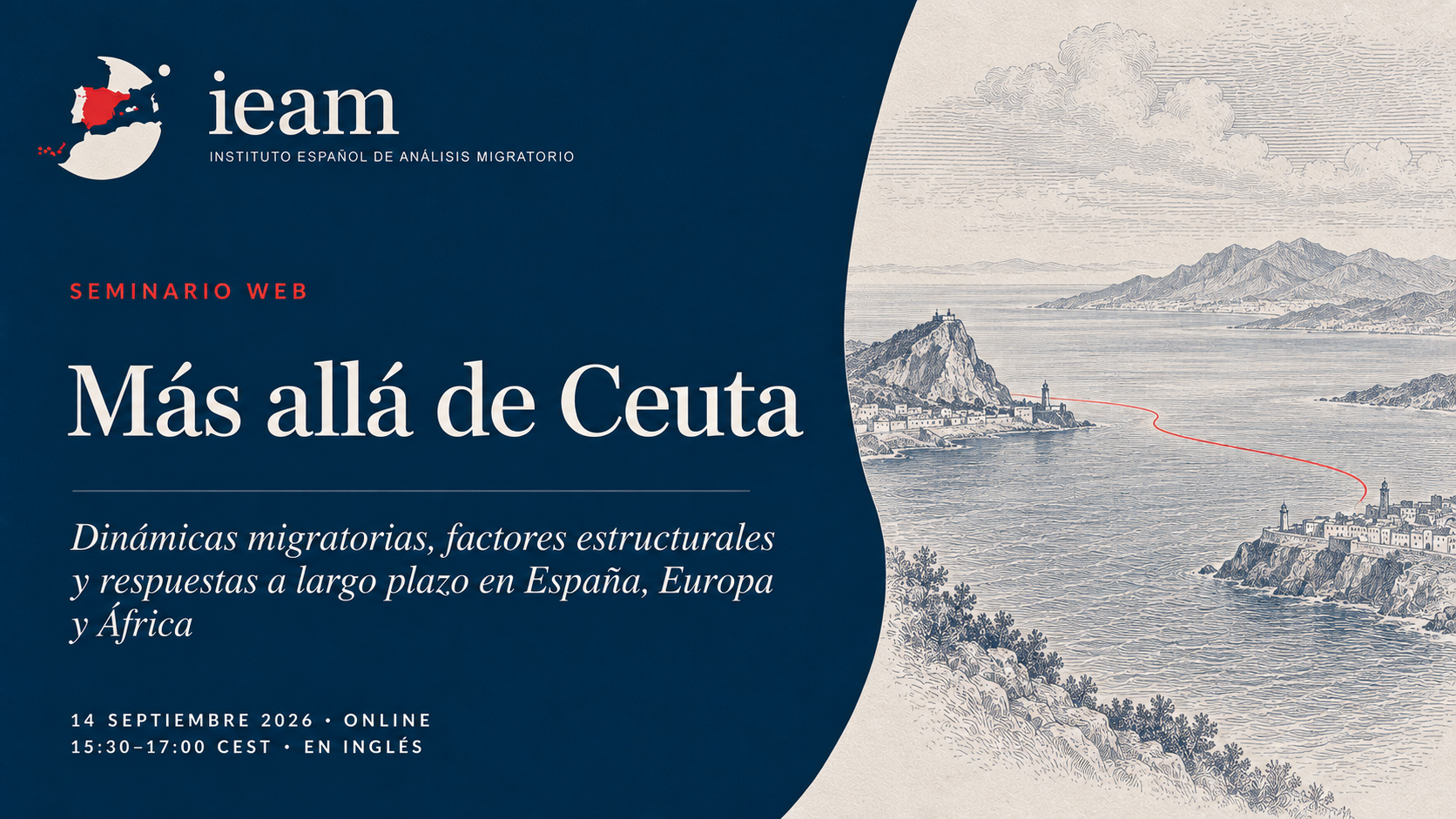
The Instituto Español de Análisis Migratorio (IEAM) held a webinar on September 14 examining the recent events in Ceuta and what they reveal about migration dynamics, structural drivers and the need for long-term responses in Spain, Europe and Africa.
The discussion used the events in Ceuta as a starting point to look beyond immediate crisis management and explore the broader factors shaping mobility between Africa and Europe. Speakers addressed the economic, social, demographic and political drivers of migration, as well as the capacity of Spain and the European Union to anticipate and respond to sudden increases in arrivals.
The session featured interventions by Diego Caballero-Vélez, Postdoctoral Researcher at the University of Latvia; Filippo Simonelli, Research Fellow at the Istituto Affari Internazionali (IAI) and PhD Candidate at the University of Siena; Beatriz de León Cobo, Executive Director of IEAM; and Amina Er-rifayi, PhD in Sociology. The virtual session was moderated by Roméo Gbaguidi, President and Research Director of LemAfriq and Associate Professor at Nebrija University, and Camille Dock, Project Manager at IEAM.
Key Themes
Migration governance, coordination and capacity
The discussion examined the capacity of Spanish and European migration systems to respond to sudden arrivals, highlighting the need for stronger coordination, clearer responsibilities and greater solidarity across different levels of governance.
Crisis response, anticipation and resilience
The speakers discussed the limits of reactive approaches, externalisation and bilateral agreements, stressing the importance of anticipation and resilience mechanisms that can sustain responses when existing arrangements come under pressure.
Structural drivers and opportunities
The webinar looked beyond immediate border events to the economic, social and demographic factors shaping migration, particularly the lack of opportunities in countries of origin and transit and the need for longer-term cooperation.
Lessons from Ceuta and long-term responses
A central conclusion was the need to move from crisis management towards more coherent and sustainable migration policies. This includes strengthening governance and reception capacity while addressing the underlying drivers of migration and incorporating African perspectives into European policy discussions.
Outputs
The discussion will inform a forthcoming IEAM Policy Paper examining how Spain and the EU can better anticipate, coordinate and sustain responses to migration pressure.