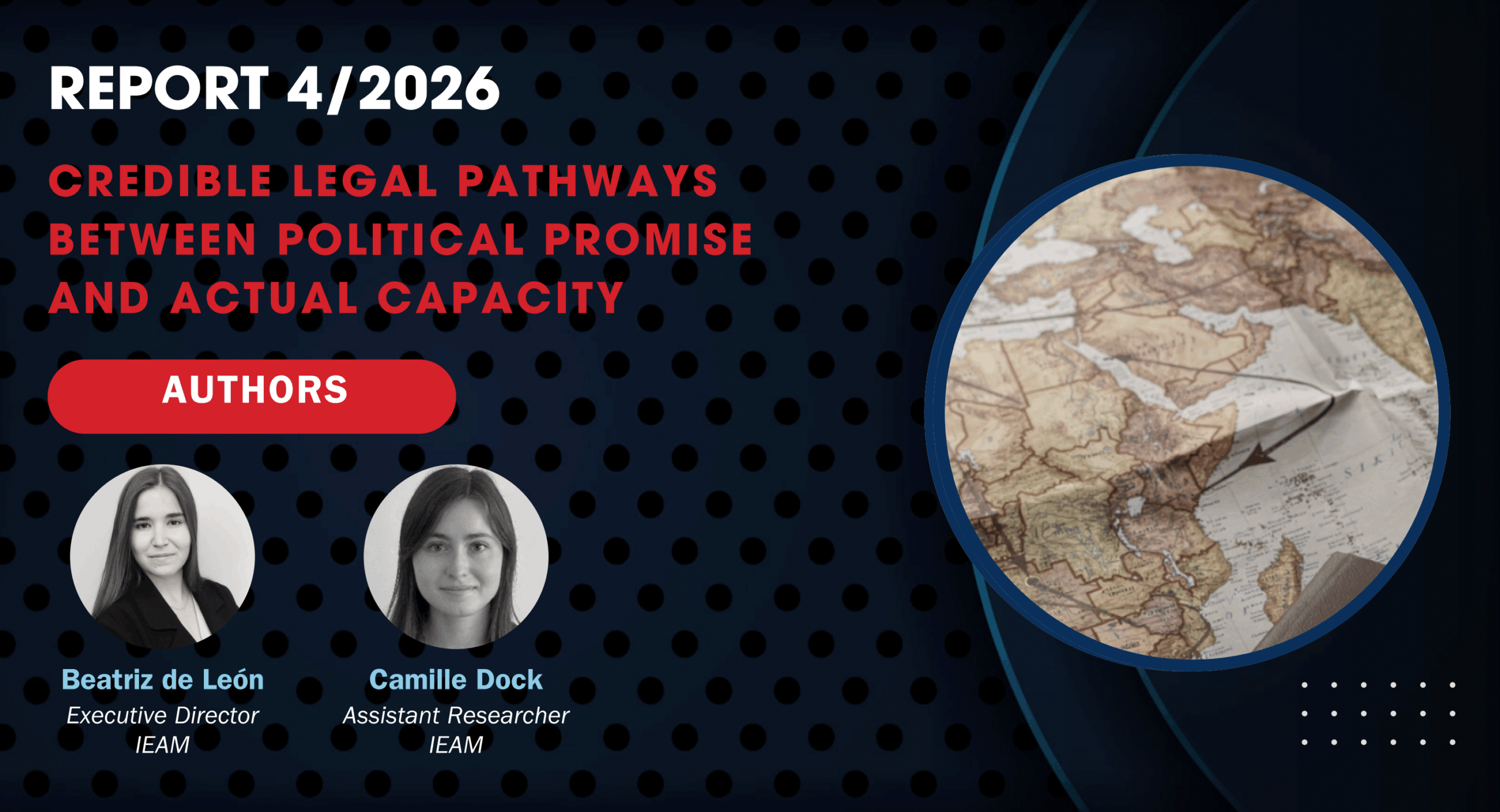
This Policy Paper sets out strategic guidance to make legal migration pathways between the European Union and its African partners credible, effective and sustainable. It seeks to move beyond short-term political visibility towards a coherent operational framework grounded in economic and territorial realities.
The paper builds on the work of the Spanish Institute for Migration Analysis (IEAM) and draws on a collective intelligence workshop held in Rome at Niccolò Cusano University, jointly organised by IEAM and the independent Italian research centre AMIStaDeS.
The workshop brought together representatives of United Nations agencies, European institutions and national ministries, humanitarian and civil society organisations, businesses and African experts. Participants compared institutional, operational and analytical perspectives on Euro-African mobility, identified structural tensions limiting existing schemes and developed proposals to turn pilot programmes into credible long-term mechanisms adapted to African partners’ capacities and priorities.
The analysis addresses a central paradox: legal pathways are politically visible but remain structurally peripheral. Circular mobility programmes can benefit individuals without significantly changing the wider dynamics of the migration system. Three persistent mismatches help explain this: the gap between programme scale and demographic pressures; a lack of trust in procedures, aggravated by opaque consular processes; and weak integration with local training, employment and reintegration strategies. These constraints are compounded by growing demographic pressures in Africa, European reception capacity shaped by political cycles and excessive reliance on short-term external funding.