The Objective
On El mundo es tu casa, IEAM’s Executive Director examines spreading insecurity in the Sahel, the predominantly intraregional nature of displacement and the region’s strategic implications for Spain and Europe.
09 JUL 2026 · IEAM Team · 5 min read
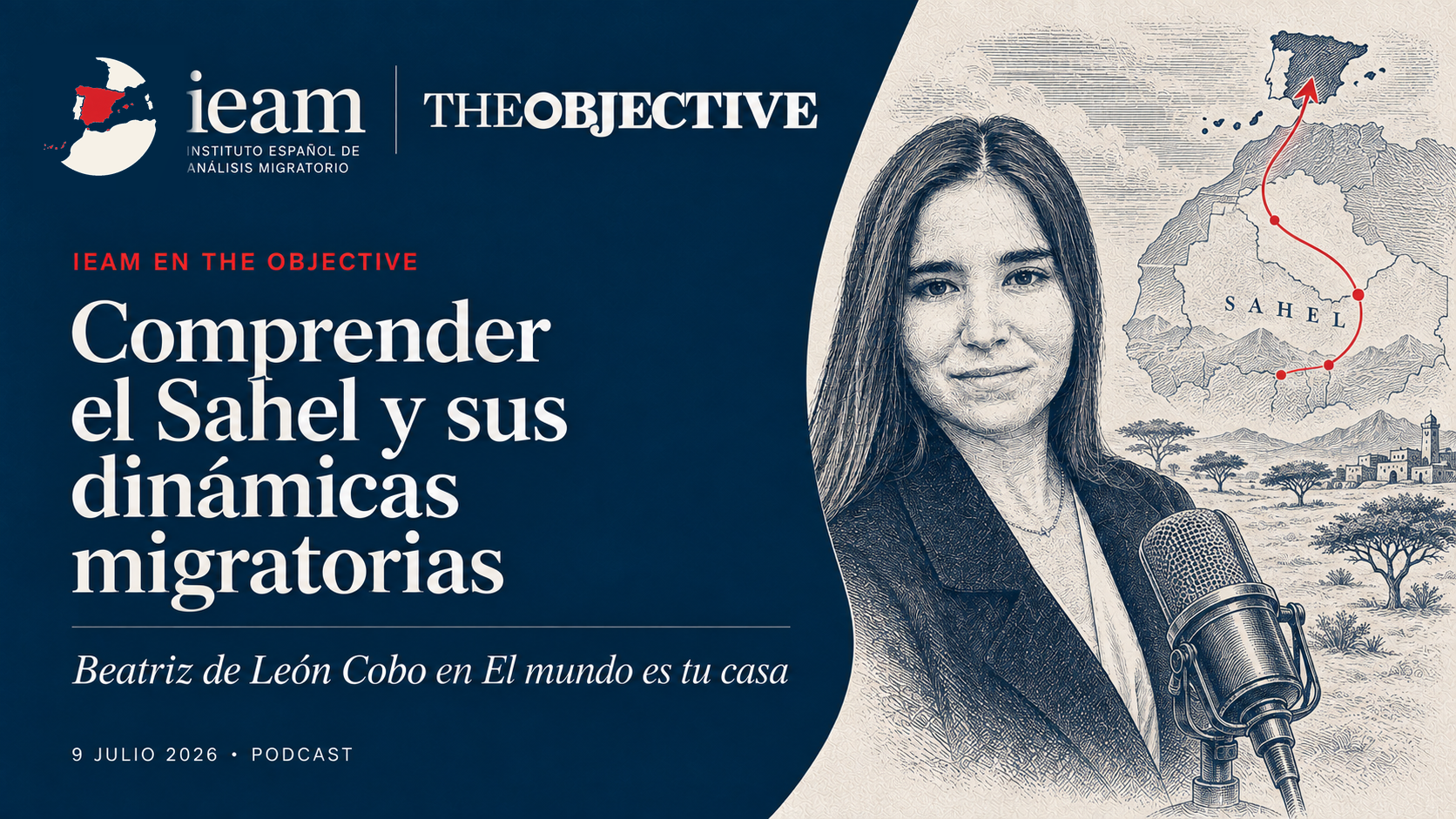
Beatriz de León Cobo, Executive Director of the Instituto Español de Análisis Migratorio —IEAM—, joined El mundo es tu casa, The Objective’s podcast in collaboration with Foro LVL, for an episode on security developments in the Sahel and their consequences for Spain and Europe.
The conversation covers the expansion of groups linked to Al-Qaeda and Islamic State, weakening state capacity, regional governments’ new international alliances and the frequently oversimplified relationship between conflict, displacement and migration towards Europe.
A crisis beyond the military dimension
The Sahel has faced deep political and security deterioration for years. Armed groups have expanded from parts of Mali into Burkina Faso and Niger, and progressively further south, while states have increased military capabilities and diversified international alliances.
Institutional weakness, the absence of the state in some areas, local conflicts, shrinking economic opportunities and deteriorating governance help create conditions in which armed groups can consolidate their presence.
Conflict, displacement and migration
A central point of the interview is the need to avoid assuming an automatic link between violence in the Sahel and migration towards Europe. People displaced by conflict initially tend to stay close to home, move to safer areas within their country or settle temporarily in neighbouring states.
Those who eventually migrate to Europe often follow more complex trajectories and, in many cases, already had a migration plan that insecurity can accelerate or alter.
Why the Sahel matters to Spain
Spain has a direct interest in understanding the region’s evolution. The Atlantic route to the Canary Islands demonstrates the connections between West Africa, the Sahel and Spanish migration dynamics. In 2024, Malian nationals arriving in the Canary Islands highlighted the need for deeper analysis of these transformations.
Sahelian communities in Spain remain relatively understudied as distinct groups. IEAM is working on this issue through a project with the Fundación FOESSA on the social inclusion of sub-Saharan migrants in Spain.
Connecting security and governance
Military pressure may contain specific threats, but lasting results are difficult to secure without legitimate institutions, economic prospects, access to public services and trust between the state and its population.
Understanding the Sahel requires bringing together security, governance, the economy, social dynamics and human mobility.
La batalla por el Sahel was published by The Objective on 9 July 2026 as part of the podcast El mundo es tu casa.