Demócrata
Two weeks after the events of 30 July, IEAM’s Executive Director calls for a shift from emergency management towards anticipation, independent operational capacity and more predictable cooperation with Morocco and the European Union.
15 AUG 2026 · IEAM Team · 5 min read
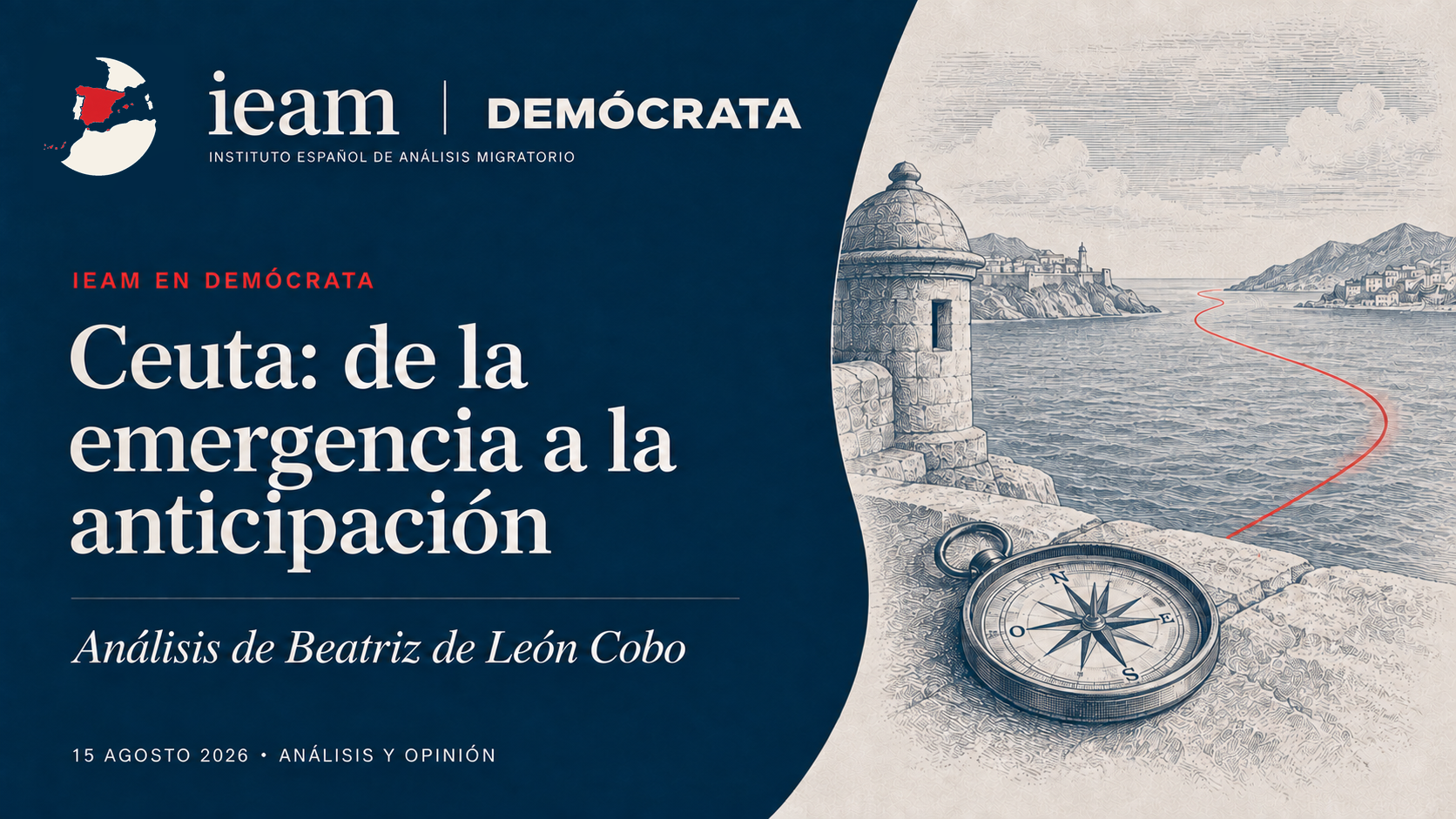
Beatriz de León Cobo, Executive Director of the Instituto Español de Análisis Migratorio —IEAM—, writes in Demócrata about the lessons Spain and Europe should draw from the border crisis of 30 July, in an article entitled Ceuta, dos semanas después: de la emergencia a la anticipación.
Easing immediate pressure does not mean that the factors behind the crisis have disappeared. The real test will be which permanent mechanisms are developed to prevent institutions from once again having to react after events have unfolded.
Reviewing events to improve the response
The first priority is a rigorous review of the sequence of events: what warning signs existed, when they were detected, when reinforcements were requested and which capacities proved insufficient.
Such a review should be understood not only as an exercise in accountability, but as a tool for improving responses to future border pressure.
From early warning to operational protocols
Monitoring social media and migration movements is genuinely useful only when connected to operational mechanisms. Early warning must translate into clear protocols: deploying additional personnel, political and operational contacts with neighbouring countries, administrative preparedness and communication with people who may be receiving false information about entry into Spain.
The aim should be to move from identifying a threat to being ready to act before it becomes difficult to manage.
Independent capacity and administrative preparedness
The article calls for a national reinforcement capacity that Spain can mobilise quickly. Large-scale arrivals require more than police officers: they also need interpreters, asylum staff, identification teams, prosecutors, age-assessment specialists and resources for handling widely differing legal circumstances individually.
Administrative preparedness is as much a part of border management as security deployments.
Predictable cooperation and European solidarity
Morocco will remain an essential partner for Spain on migration, security and combating criminal networks. The article nevertheless advocates predictable, verifiable cooperation supported by Spain’s own capacities. Partial externalisation may be useful, but should not leave Spain without alternatives when cooperation weakens or stops functioning normally.
Ceuta is also an external border of the European Union. European solidarity should be integrated into planning, anticipation, cooperation with third countries and response capacity, rather than beginning only after a crisis.
The real lesson from Ceuta will be whether Europe waits for the next emergency or uses this experience to build permanent mechanisms.
Ceuta, dos semanas después: de la emergencia a la anticipación was published by Demócrata on 15 August 2026.